Overhangs: where to set them and why cargo may still not fit
Overhang is the permitted extension of cargo beyond the body's internal boundary. Set it separately for each side of each vehicle type. It does not enlarge the physical floor or override support, loading-access, weight or axle requirements.
In this article
Where to enter values
- Open Vehicles and cost → Add vehicle or edit an existing row.
- Enter the actual body's internal dimensions.
- In the overhang section, enter the permitted extensions in millimetres: Front (F), Rear (R), Left (L), Right (R), Top (T).
- Save the vehicles and calculate again.
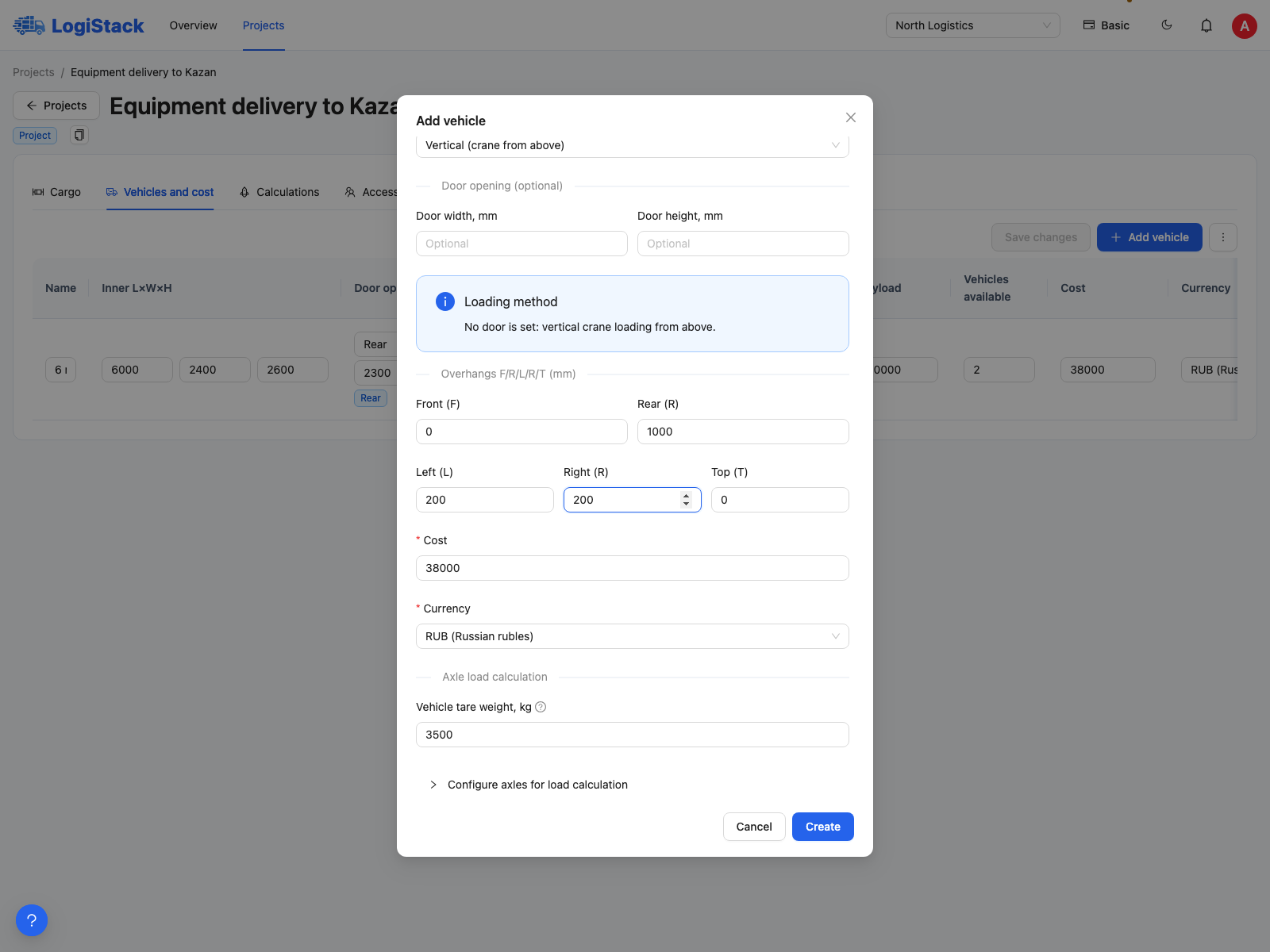
Enter all five overhang directions in millimetres. 0 prohibits extension on that side; the 300 mm rear overhang shown is an educational example.
| Field | Direction | What 0 means |
|---|---|---|
| Front | Beyond the front wall, towards the cab | Extension in this direction is prohibited |
| Rear | Beyond the rear body boundary | Extension in this direction is prohibited |
| Left and right | Beyond the side boundaries | Extension on the corresponding side is prohibited |
| Top | Above the specified internal height | Upward extension is prohibited |
The abbreviated table header uses R twice: for rear and right. Check field order against the full names rather than relying on the letter alone.
Why the specified overhang may be insufficient
Enough of the piece's base must remain within the body. In addition to absolute millimetres, the protruding fraction is limited: under the standard setting, extension on each horizontal side is limited to one quarter of the piece's dimension in that direction. Thus a 500 mm vehicle overhang allowance does not mean all 500 mm can be used by a 1000 mm-long piece.
Top overhang does not allow arbitrarily tall stacks. If an upper piece extends above the body, its immediate support must stand on the floor. Increasing top overhang therefore does not make any third or fourth tier acceptable.
Check loading access
With rear or side loading, cargo must still pass through the specified door. Permitted body overhang does not enlarge the opening. For an open platform loaded by crane, specify the actual loading method; do not change it merely to obtain a denser plan.
Checks for unplaced cargo
- Is the vehicle type with the configured overhang actually selected?
- Were changes saved before calculation?
- Is the required cargo rotation allowed?
- Does the opening fit, is support available and is weight within the limit?
- Has moving weight towards an end overloaded an axle?
Use values appropriate to the actual shipment. An entered overhang does not establish legal road dimensions or whether a permit is needed. Next: vehicle settings and axle configuration instructions.